Korle Bu suspends elective surgeries, relocates emergency cases
28 August 2024
The Korle Bu Teaching Hospital (KBTH) has announced the suspension of elective surgeries and temporary relocation of emergency cases due to ongoing issues with the lifts at the surgical block.
The hospital expressed concerns about the inability of patients to access the surgical tower, which is significantly impacting its ability to perform surgeries as usual.
To ensure critical care is not compromised, KBTH said it will focus solely on emergency cases during this period.
In a notice signed by Professor J. E. Mensah of the Surgical Department, the hospital stated, “Given the current situation, we have decided to suspend all elective surgeries until further notice. During this period, we will focus solely on emergency cases to ensure that critical care is not compromised
Korle Bu indicated that emergency surgeries will be carried out at the Ground Floor Surgical (Neuro), Accident Centre, and Pediatric and Gynaecology theatres.
“To accommodate these changes, emergency surgeries will be carried out at the Ground Floor Surgical (Neuro), Accident Centre, Pediatric and Gynaecology theatres. Patients undergoing these procedures will be admitted to Ward G, Ward N, Ward A, and Ward B.”
Korle Bu announced that the replacement of one lift and refurbishment of the other is currently in the procurement process.
The hospital assured that efforts are being made to expedite the completion of the work as soon as possible.
“We are making every effort to complete the work as quickly as possible to minimize disruption and resume normal operations.”
Spain’s PM seeks to stem surge in illegal migrants, visits West Africa
28 August 2024

Spain’s PM seeks to stem surge in illegal migrants, visits West Africa prime minister announced a series of agreements with the West African nation of Mauritania on Tuesday to stem a surge in migrants making the dangerous Atlantic journey to the Canary Islands.
Speaking alongside Mauritania’s President Mohamed Ould Ghazouani in the capital Nouakchott, Pedro Sánchez said Spain will expand its circular migration program to Mauritanians and renewed cooperation between the two nations’ security forces to combat people smuggling and trafficking networks.
“Migration is not a problem,” Sánchez said, openly recognizing the need for migrant workers in Spain’s aging society.
“It is a need that involves certain problems, and for this we must push formulas that allow us to manage the phenomenon of migration in a humane, safe and orderly way, to benefit our respective societies,” he added.
Sánchez is on a three-day tour of West Africa to reinforce bilateral relations with Mauritania, Gambia and Senegal, where the majority of migrant boats reaching the Canaries are being launched from.
The Canary Islands, a Spanish archipelago located close to the African coast and used as a stepping stone for migrants and refugees trying to reach continental Europe, has seen more than 22,000 people disembark on its shores since January, according to Spain’s Interior Ministry, more than double the number of irregular arrivals for the same period last year.
“Until not long ago Spain was also a country of migrants … they aspired for better lives, much like those who take great risks and take on this dangerous adventure,” Sánchez said.
Among those making it to the Canaries are thousands of Malian refugees fleeing violence and instability in the Sahelian nation as well as youth from Senegal, Mauritania and other West Africa who are seeking better job opportunities abroad.
There are also increasingly more teenagers and children traveling alone to the Canary Islands, which has overwhelmed the local government responsible for their care.
Spanish authorities say they are bracing for even more arrivals this fall when sailing conditions in the deadly Atlantic Ocean between West Africa and the Spanish archipelago are more favorable.
It’s the second time that the Spanish leader has visited Mauritania this year.
In February, Sánchez traveled to the largely deserted and impoverished nation alongside European Commission President Ursula von der Leyen and announced 210 million euros (around $235 million) to help the country curb migration.
Seen as a beacon of stability in the volatile Sahel region, Mauritania hosts about 200,000 Malian refugees on its border.
Sánchez thanked his Mauritanian counterpart for his cooperation and announced a new high level meeting between Spain and the Islamic Republic in 2025.
In addition to the migration and security agreements, Spain launched on Tuesday a Spanish-Mauritania business council to boost investments and announced it would open a branch of the Cervantes Institute in the country to promote Spanish language and culture.
Fourteen African countries, key partners unite to provide critical resources for health in WHO’s first-ever Investment Round
28 August 2024
In an unprecedented show of unity in support of the World Health Organization, 14 African countries and many partners pledged over US$ 45 million to the WHO Investment Round, a three-month-old initiative aimed at generating sustainable financing for the organization at the center of the global health architecture. The commitments were made during the World Health Organization (WHO) Regional Committee for Africa, with heads of state and government from across the continent underscoring the importance of investing in global health and ensuring a strong WHO.
“I thank our African Region Member States for actively supporting WHO’s first Investment Round to mobilize predictable and flexible resources needed for our core work over the next four years,” said Dr Tedros Adhanom Ghebreyesus, WHO Director-General. “Full, sustainable funding will enable WHO to support countries better in their work to build healthier, more resilient, and more prosperous populations.”
The countries and partners came together for the historic event aimed at sustainably funding WHO and thus enabling it to more effectively fulfil its mandate and advance key objectives to promote, provide and protect health and well-being for all. The countries included Botswana, Cabo Verde, Chad, Congo, Ethiopia, Gambia, Mauritius, Namibia, Niger, Rwanda, Senegal, Seychelles, South Africa, and the United Republic of Tanzania.
Many partners joined Members States in making commitments of support to WHO and committing to providing pledges later in the year, including Helmsley Charitable Trust, World Diabetes Foundation, Roche, Kuwait Fund for Arab Economic Development, the Bill & Melinda Gates Foundation, African Development Bank and the WHO Foundation.
“A strong, predictable and sustainably financed WHO is essential for our region and the world to meet the multiple health threats we face; and support the prevention of disease based on the vast evidence at our disposal,” said Dr Matshidiso Moeti, WHO Regional Director for Africa. “Every pledge and every partnership counts. Together, we can achieve a future where health and well-being are accessible to all.”
The WHO Investment Round will continue in the coming months and feature key pledging moments around the world.
Launched at the World Health Assembly in May 2024, the Investment Round aims to generate contributions that are flexible and thereby aligned with WHO’s strategy as approved by its Member States; predictably provided at the start of the four-year budget cycle to enable strategic decision-making; and resilient in that they will derive from a larger, more diverse set of donors.
Floods in Nigeria kill at least 49, displace thousands
27 August 2024

Officials remain worried over heavy rains that have caused flooding as the rainy season is yet to peak.
At least 49 people have been killed and thousands displaced in Nigeria after heavy rains caused flooding in the northeast of the country, the National Emergency Management Agency (NEMA) has said.
Three states in the northeast, Jigawa, Adamawa and Taraba, have been hit hard by floods, with 41,344 people displaced, NEMA spokesperson Manzo Ezekiel said Monday.
In 2022, Nigeria experienced its worst flood in more than a decade, which killed more than 600 people, displaced around 1.4 million and destroyed 440,000 hectares (1.1 million acres) of farmland.
“We are just entering into the peak of the season, particularly in the northern part of the country, and the situation is very dire,” Ezekiel told Reuters.
The floods have also destroyed farmlands, affecting around 693 hectares (1,712 acres) of agricultural land. Nigeria is battling double-digit inflation, which has been stoked by high food prices.
Heavy rains have added to problems in the farming sector, where farmers are deserting their farms in the northeast due to repeated attacks by armed individuals.
Many officials remain worried and are bracing for more destruction as the rainy season is yet to peak.
A rare but deadly mosquito virus infection has Massachusetts towns urging vigilance
FILE – Visitors stand near a 1921 statue of the Wampanoag leader Massasoit, center, Wednesday, June 9, 2021, on Cole’s Hill, in Plymouth, Mass. The town of Plymouth announced Friday, Aug. 23, 2024, that it’s closing public outdoor recreation facilities from dusk until dawn each day after a horse in the town was infected with eastern equine encephalitis.
A rare but deadly disease spread by mosquitoes has one town in Massachusetts closing its parks and fields each evening. Four other towns are urging people to avoid going outdoors at night.
They’re concerned about eastern equine encephalitis. State health officials announced last week a man in his 80s had caught the disease, the first human case found in Massachusetts since 2020.
The town of Plymouth, about 40 miles (64 kilometers) southeast of Boston, announced Friday that it’s closing public outdoor recreation facilities from dusk until dawn each day after a horse in the town was infected with the disease.
Meanwhile, state health officials warned that a cluster of four towns south of Worcester — Douglas, Oxford, Sutton and Webster — are at “critical risk” after a man from Oxford caught the virus.
State and local health officials urged people in those towns to avoid the peak mosquito biting times by finishing outdoor activities by 6 p.m. until Sept. 30 and then by 5 p.m. after that, until the first hard frost.
Jennifer Callahan, Oxford’s town manager, wrote in a memo that the family of the man who caught the virus in mid August had reached out to her office.
“They want people to be aware this is an extremely serious disease with terrible physical and emotional consequences, regardless if the person manages to live,” Callahan wrote.
She said the infected person had often recounted to his family how he never got bitten by mosquitoes. But just before he became symptomatic, he told them he had been bitten. She said the man remains hospitalized and is “courageously battling” the virus.
The presence of the virus in Massachusetts this year was co in a mosquito sample, and has been found in other mosquitoes across the state since then. In a 2019 outbreak, there were six deaths among 12 confirmed cases in Massachusetts. The outbreak continued the following year with five more cases and another death.
There are no vaccines or treatment for EEE.
The U.S. Centers for Disease Control and Prevention says that although rare, EEE is very serious and about 30% of people who become infected die. Symptoms include fever, headache, vomiting, diarrhea and seizures.
People who survive are often permanently disabled, and few completely recover, Massachusetts authorities say. The disease is prevalent in birds, and although humans and some other mammals can catch EEE, they don’t spread the disease.
The CDC says only a few cases of EEE are reported in the U.S. each year, with most infections found in the eastern and Gulf Coast states
Callahan said the family is urging people to take the public health advice seriously and to do their utmost to protect themselves
Indonesia destroys $1.3M of illegal imports, cracks down on underground economy
August 25, 2024
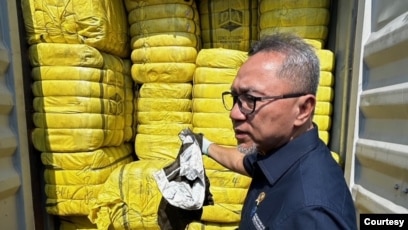
Indonesian Trade Minister Zulkifli Hasan leads an expose of illegal imported goods at the Cikarang customs and excise storage area. (Courtesy: Devianti Faridz)
JAKARTA, INDONESIA —
Cellphones, electric pots and pans, and car washing machines were among goods worth $1.3 million destroyed Monday by the Indonesian Trade Ministry in West Java. Alcoholic drinks with an ethyl alcohol or ethanol content ranging from 5% to 20% were also destroyed.
The ministry demolished the goods as part of the government’s crackdown on illegal imports, a major issue that experts say stems from Indonesia’s unpreparedness for the ASEAN-China Free Trade Agreement signed 15 years ago.
Trade Minister Zulkifli Hasan said the goods did not comply with state regulations and lacked a surveyor’s report, goods registration number, or import approval, and exceeded import quotas or failed to meet Indonesian national standards.
This is the third operation conducted by the Trade Ministry, following operations at the Cikarang customs and excise storage area in West Java and at Jakarta’s Cengkareng Port.
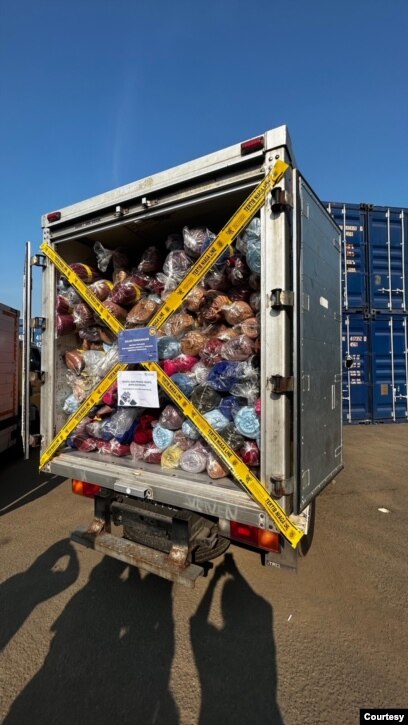
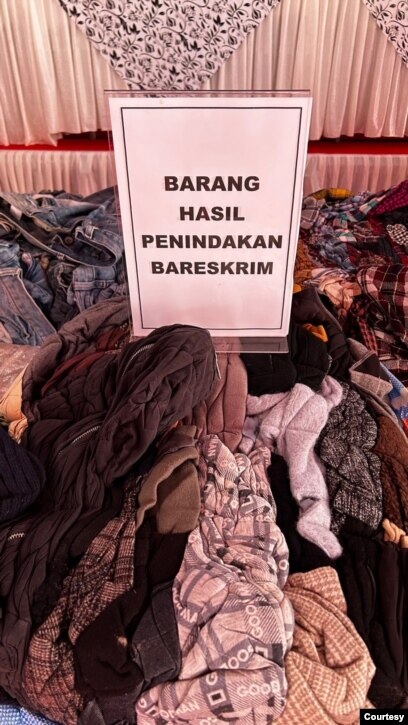
On August 6, the Trade Ministry disclosed that $2.9 million of illegal imports were stored at the Cikarang facility. The Trade Ministry confiscated 20,000 textile rolls. The National Police seized 1,883 bales of used clothing, while customs’ officers at Tanjung Priok port seized 3,044 bales of used clothing. In addition, hundreds of carpets, towels, cosmetics, footwear and more than 6,500 electronics were seized.
Since its establishment in July, the Anti-Illegal Imports Task Force has been investigating illegal import schemes, collecting data and seizing illegal goods.
The head of the Indonesian National Police’s criminal investigation unit, Wahyu Widada, said, “Illegal imports not only harm the country in terms of revenue loss, but also has an impact on small and medium scale entrepreneurs.”
Mohammad Faisal, executive director of the Center on Reform of Economics, links the current problem to Indonesia’s unpreparedness when it signed
the ASEAN-China Free Trade Agreement 15 years ago.
“Indonesia’s domestic industries were not ready to compete with China’s competitive products in the local market. Indonesia had a huge domestic market and very low trade barriers then. It’s not just tariff barriers but also the non-tariff barriers were very limited. So that’s why it’s actually easy for foreign suppliers to enter the Indonesian market,” Faisal said.
According to recent data from the Ministry of Cooperatives and Small and Medium-sized Enterprises (SMEs), approximately 50% of imported textiles and textile products are unregistered reports Voice of America (VoA). That means the state loses out on $399 million from unpaid taxes and excise duties.
In 2022, China exported $3.95 billion of textiles to Indonesia but only $2.04 billion of Chinese textile imports were recorded. Overall, the financial loss is equal to the potential creation of 67,000 jobs and over $762 million in gross domestic product. Indonesia’s GDP in 2023, according to the World Bank, was $1.37 trillion.
Zulkifli said one of the major obstacles to fighting illegal imports is the existence of an underground economy. The Minister of Cooperatives and SMEs, Teten Masduki, said that almost 30% to 40% of goods sold in Indonesian markets are involved in the underground economy and therefore the state does not receive taxes on them.
As a result, Zulkifli added that Indonesia’s tax ratio is lower than other developed Asian nations such as South Korea, Japan and China.
“Imagine if we sent illegally imported goods to South Korea or China. Don’t expect that to happen, it’s impossible. That’s why these nations can become developed countries. If our “house” continues to get burglarized, how can we move forward?” he said.
Zulfkli announced in late June a plan to impose stiff tariffs of up to 200% on some products. The plan, which is still under review, initially was announced as an import duty on Chinese goods, but the minister said later the duties would apply to all countries.
Indonesia’s Retail and Tenant Association has detected shops suspected of selling illegally imported goods online across North Sumatra to East Java, and some have opened shops at Jakarta’s wholesale shopping centers.
Budihardjo Iduansjah, chairman of the association, said “These Chinese entrepreneurs store their goods at local warehouses and sell them online. But now many have started selling at shops including at International Trade Centers.”
During a visit to shops suspected of selling illegally imported goods from China, VOA spotted clothing with labels written in Mandarin that were sold for $1 each. A seller there admitted that he and many other sellers sold their goods online and shipped the clothes in bulk to resellers across the country.

Zulkifli claims that the investigations carried out by his task force have caused many foreign nationals suspected of dealing in illegal imports to leave.
He plans to work with universities to research the root causes of illegal imports. He is confident that the illegal imports crackdown will continue under President-elect Prabowo Subianto, who will be inaugurated in October
Hurricane Hone sweeps past Hawaii, dumping enough rain to ease wildfire fears
As a result, Zulkifli added that Indonesia’s tax ratio is lower than other developed Asian nations such as South
August 25, 2024
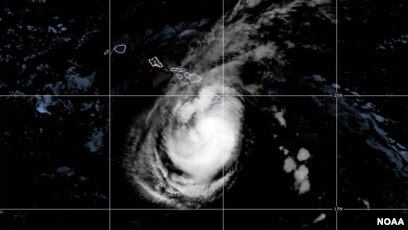
This satellite image provided by the National Oceanic and Atmospheric Administration (NOAA) shows Tropical Storm Hone was located near the Big Island in Hawaii as of 2:00 am HSST, Aug. 25, 2024, with moving west at 10 mph.
HONOLULU —
Hurricane Hone passed just south of Hawaii early Sunday, dumping enough rain for the National Weather Service to call off its red flag warnings that strong winds could cause wildfires on the drier sides of islands in the archipelago reports Voice of America
Hone had top winds of 80 mph (130 kph), according to a 2 a.m. advisory from the Central Pacific Hurricane Center in Honolulu, and was moving west near the southernmost point of the Big Island, close enough to sweep the coast with tropical storm force winds and to drop up to a foot (30 centimeters) or more of rain on the windward and southeast-facing slopes of the Big Island, with locally higher amounts possible.
Hurricane Gilma, meanwhile, increased to a Category 4 hurricane Saturday night, but it was still about 1,480 miles (2,380 kilometers) east of Hilo and forecast to weaken into a depression before it reaches Hawaii.
“Hone’s main threats to the state continue to be the potential for heavy rainfall leading to flooding, damaging winds and large surf along east-facing shores,” the weather service advised early Sunday.
Some Big Island beach parks were closed due to dangerously high surf and officials were preparing to open shelters if needed, Big Island Mayor Mitch Roth said.
Hone, whose name is Hawaiian for “sweet and soft,” poked at memories still fresh of last year’s deadly blazes on Maui, which were fueled by hurricane-force winds. Red flag alerts are issued when warm temperatures, very low humidity and stronger winds combine to raise fire dangers. Most of the archipelago is already abnormally dry or in drought, according to the U.S. Drought Monitor.
“They gotta take this thing serious,” said Calvin Endo, a Waianae Coast neighborhood board member who lives in Makaha, a leeward Oahu neighborhood prone to wildfires.
The Aug. 8, 2023, blaze that torched the historic town of Lahaina was the deadliest U.S. wildfire in more than a century, with 102 dead. Dry, overgrown grasses and drought helped spread the fire.
For years, Endo has worried about dry brush on private property behind his home. He’s taken matters into his own hands by clearing the brush himself, but he’s concerned about nearby homes abutting overgrown vegetation.
“All you need is fire and wind and we’ll have another Lahaina,” Endo said Saturday. “I notice the wind started to kick up already.”
The cause of the Lahaina blaze is still under investigation, but it’s possible it was ignited by bare electrical wire and leaning power poles toppled by the strong winds. The state’s two power companies, Hawaiian Electric and the Kauai Island Utility Cooperative, were prepared to shut off power if necessary to reduce the chance that live, damaged power lines could start fires, but they later said the safety measures would not be necessary as Hone blew past the islands.
Roth said a small blaze that started Friday night in Waikoloa, on the dry side of the Big Island, was brought under control without injuries or damage.
NASA Boeing Starliner crew decides to stay in space until 2025, will return home on SpaceX
NASA leaders announced Saturday that the two Boeing Starliner astronauts, Barry “Butch” Wilmore and Sunita “Suni” Williams, are officially looking at a lengthy eight-month stay aboard the International Space station
Barry “Butch” Wilmore and Sunita “Suni” Williams will have to wait it out until February after a flight readiness review determined that it’s too risky for them to return to Earth on the Boeing spacecraft, NASA leaders announced Saturday.
The decision means the Starliner will return emptyhanded to Earth to free up a docking port for SpaceX Crew-9, which is scheduled to reach the space station Sept. 24 for a six-month rotation mission. The Dragon capsule that Crew-9 will take to orbit is also now Williams and Wilmore’s ride home.
“The decision to keep Butch and Suni aboard the International Space Station and bring the Boeing Starliner home uncrewed is result of a commitment to safety,” NASA’s Administrator Bill Nelson said during the news conference. “Our core value is safety, and it is our North Star. And I’m grateful to NASA and to Boeing, for their teams, for all the incredible and detailed work to get to this decision.”
During the news conference, NASA’s administrators said that safety is their main priority, but the government agency plans to use this experience as an opportunity to learn.

‘ll tell you that the NASA and Boeing team have made incredible technical progress in the model development that has gone on, the thruster testing, understanding material properties within the valve and the complicated fluid physics that are happening inside,” NASA’s Associate Administrator Jim Free said. “We are a learning organization, and I think we’ve demonstrated that here. We’ll learn from this effort so that our crews who are at the top of the pyramid on these missions and their families can continue to know we’ve done that, and we’ll always do our best.”
Humanitarian aid resumes in Sudan’s war-torn Darfur after 6-month border closure
August 24, 2024

A handout image released on August 21 shows aid trucks with relief supplies for Sudan’s Darfur region, at a location given as the border of Chad and Sudan
Food deliveries have resumed to Sudan’s famine-threatened Darfur region following the reopening of a key border crossing by Sudanese authorities after a six-month closure, as civil war rages in the country.
The United Nations food agency said in a statement on Wednesday that the first convoy of trucks laden with essential food supplies has arrived in Darfur from neighboring Chad through the reopened Adre border.
The supplies are intended for 13,000 people in Kereneik in Darfur, who are at imminent risk of famine, the World Food Programme (WFP) said.
“WFP has food and nutrition supplies for around 500,000 people ready to move swiftly through the newly re-opened route,” the WFP statement added.More than 10 million people have fled their homes and at least 18,000 others have been killed since civil war broke out in April 2023 between the Sudanese Armed Forces (SAF) and the paramilitary Rapid Support Forces (RSF), according to the UN Office for the Coordination of Humanitarian Affairs (OCHA). Over half the country’s population now faces acute hunger, it reported in a statement last month.The Adre crossing, offering the most direct and efficient route for delivering aid to Darfur from Chad, enables trucks to reach key distribution points within a day.
During the border’s closure, WFP said it managed to send only two convoys via Adre, relying instead on longer, more dangerous routes that often navigated conflict zones controlled by various militia groups.
Last week, the Sudanese government agreed to open key border crossings for humanitarian aid amid international pressure.
Sudan’s Sovereign Council announced that it would open the Adre crossing on the country’s border with Chad for three months after it was closed in February by the Sudanese army, which alleged that the crossing was being used to move weapons.
According to the UN OCHA, 26 million people in Sudan need assistance — more than half of the country’s population.
Italy’s foreign minister says country needs more African students
Aug 23 2024

Foreign minister Antonio Tajani said on Thursday that he wanted more African students to come to Italy, in remarks that may exacerbate a coalition squabble over immigration and citizenship rights.
Tajani’s centre-right Forza Italia party has urged the government to consider granting citizenship to foreign Africans who have completed most of their education in Italy.
The proposal has met with opposition from the two hard-right coalition parties, Prime Minister Giorgia Meloni’s Brothers of Italy and Matteo Salvini’s League.
I think the numbers of African students studying in Italy should be increased”, Tajani said at a Catholic business and politics conference in Rimini, on the Adriatic coast.
 mkdmissions.home.blog