It destroyed Ghana’s image – National Peace Council decries loss of lives in Election 2020
Aug 22 2024

Joana Opare speaking at the event
The National Peace Council has acknowledged that the deaths of eight people during the 2020 elections tarnished Ghana’s reputation, despite the general perception of the elections as peaceful
The Council emphasized that it is currently engaging with stakeholders to prevent such tragedies in the future, stressing that no election should ever result in the loss of life.
A Board Member of the National Peace Council, Joana Opare made these remarks at the ongoing Public Forum on Media, Peace, and Democratic Consolidation in Accra.
“One of them came especially from the stakeholder meeting by CODEO that especially highlighted and I quote, the deaths that were recorded in the 2020 general elections had dented Ghana’s image. Excellencies, under no circumstances should elections lead to the death of any lives,” she said.
To move beyond this collective pain, we have had a lot of consultations with all stakeholders, the political parties, their leadership, the media and so on to ensure that we are all moving in the right direction to keep Ghana as a peaceful country,” she added.
National Productivity Centre plans one million jobs
21st August 2024, News from Nigeria

The National Productivity Centre in Nigeria has announced a plan to create one million jobs without depending on government funding.
According to a statement by the Head of Press and Public Relations at the Ministry of Labour and Employment, Mrs Patience Onuobia, the newly appointed Director-General of the NPC, Mr Baffa Dan’agundi, revealed this initiative during a recent courtesy visit to the Minister of State for Labour and Employment in Abuja.
He stated that the plan aimed to boost employment by supporting entrepreneurship, developing skills, and investing in high-growth sectors, minimising reliance on government funds.
He also requested the minister’s support in securing presidential approval for the project.
Protester lament low turnout of Nigerians for the hunger protest day 5
Dan’agundi expressed confidence in the minister’s experience and assured that, under his leadership, the NPC was dedicated to achieving its goals.
“With the President’s approval, we can create one million jobs for Nigerians without relying on government funds.
“This initiative will be groundbreaking and will have a lasting impact. I am committed to making it a reality and believe that with your support, we can achieve these goals for the benefit of our country,” he averred.
The NPC DG pledged to carry out his responsibilities with excellence and expressed his gratitude to the President for deeming him worthy of the appointment.
The Minister of State for Labour and Employment, Mrs Nkeiruka Onyejeocha, urged the NPC to explore innovative job creation methods, assuring government support for creative solutions to unemployment.
She highlighted that the NPC’s plan to create one million jobs aligned with the ministry’s goal of 2.5 million jobs through the Labour Employment and Empowerment Programme.
Onyejeocha encouraged the team to approach the initiative with the same dedication as their projects.
“When I announced the Labour Ministry’s goal of 2.5 million jobs in a year, some were sceptical. With your initiative to create one million jobs, I am confident we will surpass that target.
“I am glad you are funding this without relying on government resources and offering my full support. This ministry is dedicated to reducing poverty and creating wealth, and I will work to ensure the NPC’s success.
“I feel truly fortunate to have you as the Director General of the NPC, given your proven productivity,” Onyejeocha stated.
She expressed confidence in the capabilities of the NPC DG, citing his exceptional work during the 2023 election.
Sicily yacht sinking: Morgan Stanley International chair Jonathan Bloomer among missing
August 21 2024
UK tech entrepreneur Mike Lynch and daughter also among six unaccounted for after superyacht was hit by tornado and sank
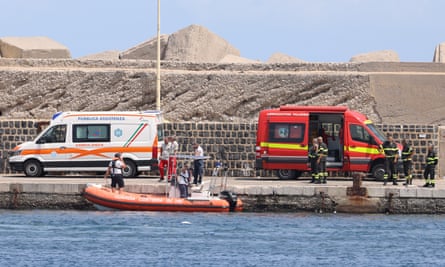
Morgan Stanley International chairman Jonathan Bloomer is among those missing after a yacht carrying UK tech entrepreneur Mike Lynch sank off the coast of Sicily during a violent storm, an Italian official has said.
Salvatore Cocina, head of the civil protection agency in Sicily, said Bloomer and Chris Morvillo, a lawyer at Clifford Chance, were among the six people missing. Lynch and his 18-year-old daughter, Hannah, were also unaccounted for as of late Monday.
The update came as it was reported that Lynch’s co-defendant in a US trial related to the sale of his software company to Hewlett-Packard had died after being hit by a car in England.
The British-flagged Bayesian, a 56-metre sailboat, was carrying 22 people and anchored just off shore near the port of Porticello when it was hit by a tornado in the early hours of Monday morning, the Italian coastguard said in an earlier statement.
One man, understood to be the vessel’s chef, was confirmed dead. The coastguard said the missing had British, American and Canadian nationalities.
Fifteen people were rescued, including Lynch’s wife, Angela Bacares, who owned the boat, and a one-year-old girl who was saved by her mother.
A spokesperson for Lynch, the co-founder of Autonomy software firm that became one of the shining lights of the UK tech scene, declined to comment. Survivors said the trip had been organised by Lynch for his work colleagues.
Once described as Britain’s Bill Gates, Lynch spent much of the last decade in court defending his name against allegations of fraud related to the sale of his software firm, Autonomy, to the US tech company Hewlett-Packard for $11bn.
The 59-year-old was , after he had spent more than a year living acquitted by a jury in San Francisco in June in effect under house arrest.
Hours after news of the sinking broke it emerged that his co-defendant at that trial, Stephen Chamberlain, had died after being hit by a car while out running in Cambridgeshire.
Chamberlain, the former vice-president of finance at Autonomy, was hit on Saturday morning and had been placed on life support. In a statement Chamberlain’s lawyer, Gary Lincenberg, said he had died after being “fatally struck” by a car while out running.
On Monday, rescue divers were trying to reach the hull of Bayesian, which was carrying a crew of 10 people and 12 passengers, according to the Italian coast guard.
The boat had sunk to approximately 49 metres and the public prosecutor’s office in Termini Imerese was investigating the incident.
“The wind was very strong. Bad weather was expected, but not of this magnitude,” a coast guard official in the Sicilian capital Palermo told Reuters.
The captain of a nearby boat told Reuters that when the winds surged, he had turned on the engine to keep control of his vessel and avoid a collision with the Bayesian, which had been anchored alongside him.
“We managed to keep the ship in position and after the storm was over, we noticed that the ship behind us was gone,” Karsten Borner told journalists. The other boat “went flat on the water, and then down,” he added.
He said his crew then found some of the survivors on a life raft – including a baby girl and her mother – and took them on board before the coast guard picked them up.
Eight of those rescued, including the one-year-old, were transferred to hospitals and were all in a stable condition.
Domenico Cipolla, a chief physician at the Di Cristina hospital in Palermo where the one-year-old girl and her mother were admitted, said: “The baby is doing well. The mother is also in good condition, albeit with some minor abrasions. The father will also be discharged from the hospital soon.
“They have said that most of them were colleagues who worked for Lynch. They are deeply traumatised. As time passes, they realise more and more that this morning they lost many friends.”
New Zealand’s ministry of foreign affairs confirmed two New Zealanders were on board the yacht.
New Zealand lawyer Ayla Ronald was named as one of the survivors. Her father, Lin Ronald, confirmed to the Guardian his daughter was safe but shaken after the event.
Ronald is employed at international law firm Clifford Chance, and had been working in London on Lynch’s long-running fraud case, her father said.
Storms and heavy rainfall have swept down Italy in recent days after weeks of scorching heat, which had lifted the temperature of the Mediterranean sea to record levels, raising the risk of extreme weather conditions, experts said
“The sea surface temperature around Sicily was around 30C (86F), which is almost 3 degrees more than normal. This creates an enormous source of energy that contributes to these storms,” said meteorologist Luca Mercalli.
India’s top court forms doctors’ panel on workplace safety after trainee is raped and murdered
Aug 21 2024
Doctors across the country have held protests and refused to see non-emergency patients after the woman died at a state-run hospital in Kolkata.
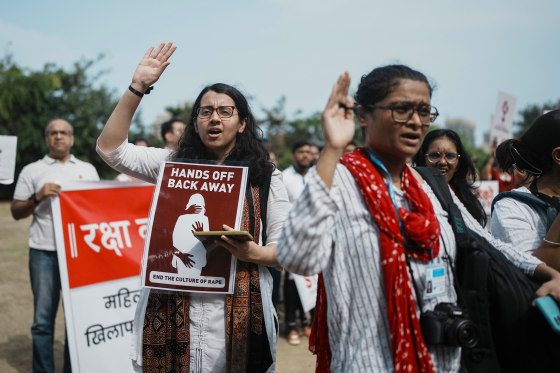
A protest in Mumbai on Monday over the Aug. 9 rape and murder of a trainee doctor at a government hospital in Kolkata.
NEW DELHI — India’s Supreme Court ordered on Tuesday the setting up of a national task force of doctors to make recommendations on safety at their workplace, days after the rape and murder of a 31-year-old trainee doctor set off nationwide protests.
The court also asked the federal police to submit a report on Thursday on the status of its investigation into the Aug. 9 murder of the trainee doctor at a state-run hospital in the eastern city of Kolkata.

Doctors across the country have held protests and refused to see non-emergency patients following the crime as part of their action demanding a safer workplace and a swift criminal investigation
A police volunteer has been arrested and charged with the crime. Female activists say the incident has highlighted how women in India continue to suffer from sexual violence despite tougher laws brought in after the 2012 gang-rape and murder of a 23-year-old student on a moving bus in New Delhi.
A legacy of peace: Honouring Kofi Annan’s enduring impact
August 21, 2024. News from Ghana
In a world often challenged by discord and division, Kofi Annan emerged as a steadfast beacon of hope, dedicating his life to the pursuit of peace, human rights, and global cooperation.
As we reflect on his monumental contributions, we are reminded of a leader whose vision and actions have left an indelible mark on the world stage.
Kofi Annan’s journey from his early years in Ghana to his pivotal role as Secretary-General of the United Nations is a testament to his relentless commitment to promoting global harmony.
For over four decades, he worked tirelessly to bridge divides, resolve conflicts, and advocate for the rights and dignity of all people. His efforts were not just diplomatic achievements; they were acts of profound humanity that continue to resonate across continents.
One of Kofi Annan’s most significant legacies is his role as the architect of the Millennium Development Goals (MDGs). These goals, which focused on eradicating poverty, reducing inequality, and combating disease, galvanized the international community to take decisive action.
Kofi Annan’s vision for a more equitable world laid the foundation for sustainable development initiatives that continue to shape global policies today. His leadership in these areas not only addressed immediate needs but also set a course for long-term global progress.
In recognition of his relentless dedication to peace and security, Kofi Annan was awarded the Nobel Peace Prize in 2001. This honour was not just a reflection of his past achievements but also a beacon for future generations to follow. Annan’s receipt of the Nobel Peace Prize underlined his belief in diplomacy, dialogue, and the power of collective action to create a better world.
Today, the Kofi Annan International Peacekeeping Training Centre (KAIPTC) stands as a living tribute to his legacy. As an institution devoted to nurturing the next generation of peacekeepers, KAIPTC embodies Kofi Annan’s ideals by providing critical training, research, and education in peacekeeping and conflict resolution.
Our work at the Centre continues to be guided by the principles he championed, making sure that his vision for a peaceful and secure world lives on.
On this anniversary of his passing, we at KAIPTC reflect on Kofi Annan’s lasting influence. His life’s work challenges us to continue striving for a world built on unity, compassion, and mutual understanding.
As we honour his memory, we recommit ourselves to his mission, knowing that together, we can build a future where peace is not just an aspiration, but a reality for all.
No One Should Feel Proud of Not Knowing Math,’ Says the only Latin American to Win the Fields Medal
Brazilian Artur Avila, who received the award considered the ‘Nobel of Mathematics,’ sees progress in the field but calls for state policy
Aug 21 2024
For Artur Avila, one of Brazil’s leading scientific figures and the country’s most renowned mathematician, no one should feel proud of not knowing mathematics. “It’s like an excuse, as if someone said they can’t read a restaurant menu because they’re ‘into the sciences.’”

(240410) — TIANJIN, April 10, 2024 (Xinhua) — French-Brazilian mathematician Artur Avila delivers a lecture at Nankai University in Tianjin Municipality, north China, April 3, 2024. (Nankai University/Handout via Xinhua)
Ten years after winning the Fields Medal, an honor awarded only every four years and to those who have made extraordinary achievements before the age of 40, Artur has taken on the role of being the face of mathematics in Brazil and a representative of the country at events abroad.
He is currently a full professor at the University of Zurich (Switzerland) and remains connected to the Institute of Pure and Applied Mathematics in Rio de Janeiro as a distinguished researcher.
He does not yet have students in the country but says he is open to discussions and co-supervision. He has mentored disciples from different parts of the world. “It’s essential that each student develops their own way of doing mathematics. My role is not to try to create copies of myself. I value independent students,” he says.
The researcher finds the mathematics landscape in Brazil impressive. “In the last 70 years, the country has seen significant progress in the field, regardless of the political and economic crises it has faced. This is evidence that we have high-quality leadership.”
“Mathematics has a particular advantage: it doesn’t require expensive laboratories or sophisticated inputs. On the other hand, the lack of a state science policy, one that goes beyond governments, is still a big challenge,” he says. “Science needs to be a long-term project, with stability, so that we can achieve solid results.”
Could Australia become a green hydrogen superpower?
20 August 2024
“If you remember being a kid and blowing up a balloon or into a milkshake, your cheeks got sore because there is an energy penalty associated with bubble formation.”
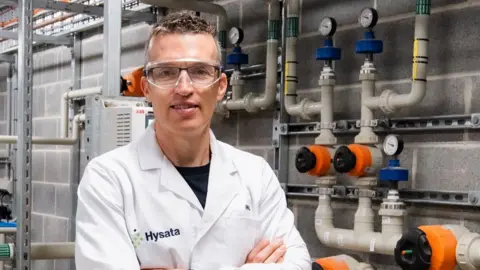
Paul Barrett, the Dublin-born chief executive of the Australian green energy firm Hysata, is explaining the plan to create the cheapest hydrogen in the world – by eliminating bubbles.
The company, based at Port Kembla, an industrial hub south of Sydney, is using a familiar process known as electrolysis, which involves passing electricity through water to split it into hydrogen and oxygen.
But Hysata has developed a special material which sits in the water and which it says makes its electrolyser much more efficient than competing products.
The company says it can produce a kilo of hydrogen using 20% less electricity than conventional methods.
Hydrogen is the most abundant element on the planet and, crucially, when used as a fuel or in industrial processes it does not produce carbon dioxide (CO2).
Many see hydrogen as the answer to cutting carbon dioxide emissions, particularly in heavy industry like steelmaking and chemical production.
Hydrogen production comes in four varieties – green, grey, blue and black.
The green variety is produced with renewable energy, grey comes from splitting methane into carbon dioxide and hydrogen, while blue is made in the same way, but the CO2 by-product is captured and stored.
The production of black hydrogen comes from partially burning coal.
But if there is to be a transition to green hydrogen then its supply needs to be massively increased.
“Ensuring you have the production of green hydrogen close enough to the demand point and being able to regulate the supply of that is probably the biggest challenge,” explains Dr Liam Wagner, an associate professor at Perth’s Curtin University.
“The efficiency of production and the amount of energy required to run these processes is the biggest frontier.”

Australia is rich in natural resources and has long been the world’s quarry. It’s an export-driven nation; its coal has helped to power Japan, while its iron ore has underpinned much of China’s growth. Many hope that hydrogen could follow.
“The prospects for hydrogen are as a way of exporting energy to countries that can’t produce enough of their own either as hydrogen in a liquid form or as ammonia, which I think is the most likely,” Dr Wagner adds.
Hysata hopes to play a part in that. Its device was initially invented by researchers at the University of Wollongong in the state of New South Wales.
In a conventional electrolyser, bubbles in the water can be clingy and stick to the electrodes, clogging up the process and leading to energy loss.
By using a sponge-like material between the electrodes, Hysata eliminates those troublesome bubbles.
“It is not unlike your kitchen sponge in terms of what it does. It is just a lot thinner,” says Mr Barrett.
“It’s pretty easy to manufacture at a super low cost,” he adds.
Cost and efficiency have been major hurdles for the hydrogen sector, but Hysata has recently raised US$111m (£87m) in investment to beef up its production.
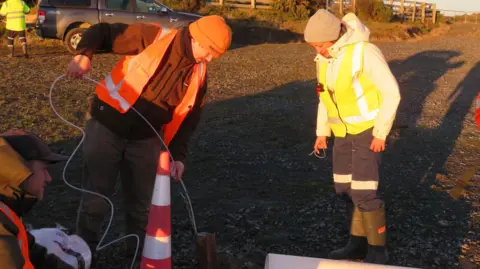
What we are speaking about is natural hydrogen which is coming directly from the earth,” explains Dr Ema Frery, a research team leader at CSIRO, Australia’s national science agency.
“A lot of rocks that are in Australia can produce hydrogen. We have a lot of old granites that are now close to the subsurface and can generate hydrogen through radiogenic processes.”
So-called geogenic hydrogen is also known as white or gold hydrogen.
Dr Frery, a French-born geoscientist based in Western Australia, is investigating how it might be extracted, stored and used in an economically viable way.
“A conventional hydrogen system can consist of a rock capable of generating hydrogen at a given rate, migration pathways and a reservoir where the hydrogen can be stored.
“Surface seeps at the top of the reservoir can indicate the presence of a hydrogen system at depth,” she says. “It is happening in other countries. In Mali, people are extracting natural hydrogen from the ground for more than ten years to produce electricity for a local village.”
Despite the research work, some doubt that hydrogen will become a big export for Australia.
One of those is the Institute for Energy Economics and Financial Analysis (IEEFA), a global research organisation which advocates the use of renewable energy.
Exporting hydrogen from Australia would “make no financial sense”, according to Amandine Denis-Ryan, the chief executive of the IEEFA in Australia.
“Hydrogen shipping would be prohibitively expensive. It requires extremely low temperatures and large volumes, and involves high losses. Using hydrogen locally makes much more sense.”
She hopes that government funding will not be “wasted” on such projects.
Like bubbles on electrodes, new technologies and processes invariably hit sticky patches where progress is hindered and doubts amplified, but the architects of hydrogen’s advance are confident it has a key part to play in our energy transition.
Bahman Shabani, a professor at RMIT University’s School of Engineering in Melbourne, is working to store surplus renewable energy using an electrolyser, a storage tank and a fuel cell that together act like a battery.
“Hydrogen is gaining popularity all around the world. If you look at the investment levels in China, for example, in Japan, in Germany, in Europe in general, in the United States, they are all realising the importance of this area.”
WASSCE begins: New chapter unfolds for students
Aug 20 2024 , 14:20

It is time, once again, for our teenagers and the future leaders of the country to contend with one of the crucial tests in their young lives, sitting the West African Senior School Certificate Examination (WASSCE) for School Candidates.
This represents a 2.66 per cent increase from last year’s figure.
It will also be time for the candidates to bring to finality a three-year search for academic excellence, knowledge and information amid the many difficulties in the schooling process at this stage of the academic ladder.
For the third consecutive time, Ghana will be conducting the WASSCE independently, having adopted a new calendar occasioned by the COVID-19 pandemic in 2020.
While Ghana’s counterparts in Nigeria, Liberia, Sierra Leone, and The Gambia have reverted to the May/June calendar, Ghana has remained on a lone path because of the peculiar circumstances of the country’s educational and other national issues.
As the Ghanaian students embark on this critical journey, we wish them the very best. We recognise the hard work, dedication and perseverance that have brought them this far.
We also acknowledge the tireless efforts of teachers, parents and guardians who have supported them every step of the way.

The WASSCE is more than just an examination; it is a rite of passage, a gateway to new opportunities and a chance to shape the future. We urge our students to embrace this challenge with confidence, to showcase their knowledge, skills and talents, and to make Ghana proud.
As we begin this new chapter, the candidates should remember that education is the bedrock of the nation’s development. Let us continue to invest in our students, our teachers and our schools. Let us strive for excellence, innovation and inclusivity.
To the candidates, we urge you to go forth, make your mark, and write your own success story. Ghana is counting on you.
We remind all the candidates that there is nothing rewarding in any form of examination malpractice; it has the potential, rather, to truncate the education and the potential bright future of a candidate.
It is important for the stakeholders in the examination, especially supervisors and invigilators, to exercise a high sense of vigilance to safeguard the integrity of the examination.
Candidates must strictly heed the advice to “adhere to the rules and regulations of the examination and be wary of the activities of rogue website operators, whose primary duty is to circulate fake questions and lure candidates into subscribing to these questions, thereby taking their focus off their books”.
We wish the candidates success in their examination, and also subscribe to the fact that “they can pass the examination without cheating”.
MONKEYPOX IN DRC
After COVID and Ebola, doctors take on mpox amid conflict in eastern DRC
The mpox outbreak puts pressure on the eastern region already struggling with a lack of medicines and an ongoing armed rebellion.

Published On 20 Aug 2024
Goma, Democratic Republic of the Congo – It’s dawn at the mpox treatment site at Nyiragongo General Referral Hospital, north of the city of Goma, and Congolese medics are already hard at work, calmly and efficiently screening, isolating and caring for patients infected with the disease.
Two days prior, the World Health Organization (WHO) issued its highest alert level for mpox after the Africa Centres for Disease Control and Prevention (Africa CDC) declared the viral disease previously known as monkeypox a continental emergency.
break since 2022 amid medicine shortages, an ongoing rebellion in the east, and after years toiling on the front lines of Ebola epidemics – the challenges have become routine.
In between the stream of patients visiting the Nyiragongo Hospital for all number of ailments, teams of hygienists and other health providers tend to mpox patients in a separate white tented area where those suffering from the highly infectious disease can be isolated to avoid any risk of contamination.
Among them, shopkeeper Madam Nyota Joyeuse is resting in a small three-bed tent. The 35-year-old mother of two fell ill about a week prior.
She had a headache, fever, muscle aches and a slight flu, so assumed it was malaria, which is common in North Kivu. But when her symptoms weren’t easing days later, she finally came to the clinic.
“I felt as if the whole universe had fallen on my head when I was told I had monkeypox,” she tells Al Jazeera, worried that her health had deteriorated and her business would come to a halt.
But the treatment she’s receiving is helping her. “Fortunately, that’s promising. May the Almighty bless those who take care of us,” she says from her hospital bed.

‘Monkeypox’ to mpox
Originally named “monkeypox” when it was first identified in monkeys in 1958, the name of the disease was updated to “mpox” in 2022 to reduce stigma.
Endemic to parts of Central and West Africa, mpox is related to the virus that caused the now-eradicated smallpox, and can be fatal in severe cases
Although outbreaks are common in DRC, health experts say the recent rise is due to a new strain, clade 1, that is spreading faster and wider than ever before.
This week, the WHO said cases have been detected in 13 African countries, as well Sweden, Pakistan and the Philippines.
The Africa CDC said cases are up 160 percent in 2024 compared with the same period last year.
In DRC the disease has been detected in all 26 provinces. As of this week, the country recorded more than 16,000 cases of mpox, resulting in about 570 deaths this year.
JAPAN’S TYPHOON
Japan braces as powerful Typhoon Ampil strengthens near Tokyo
Fri August 16, 2024
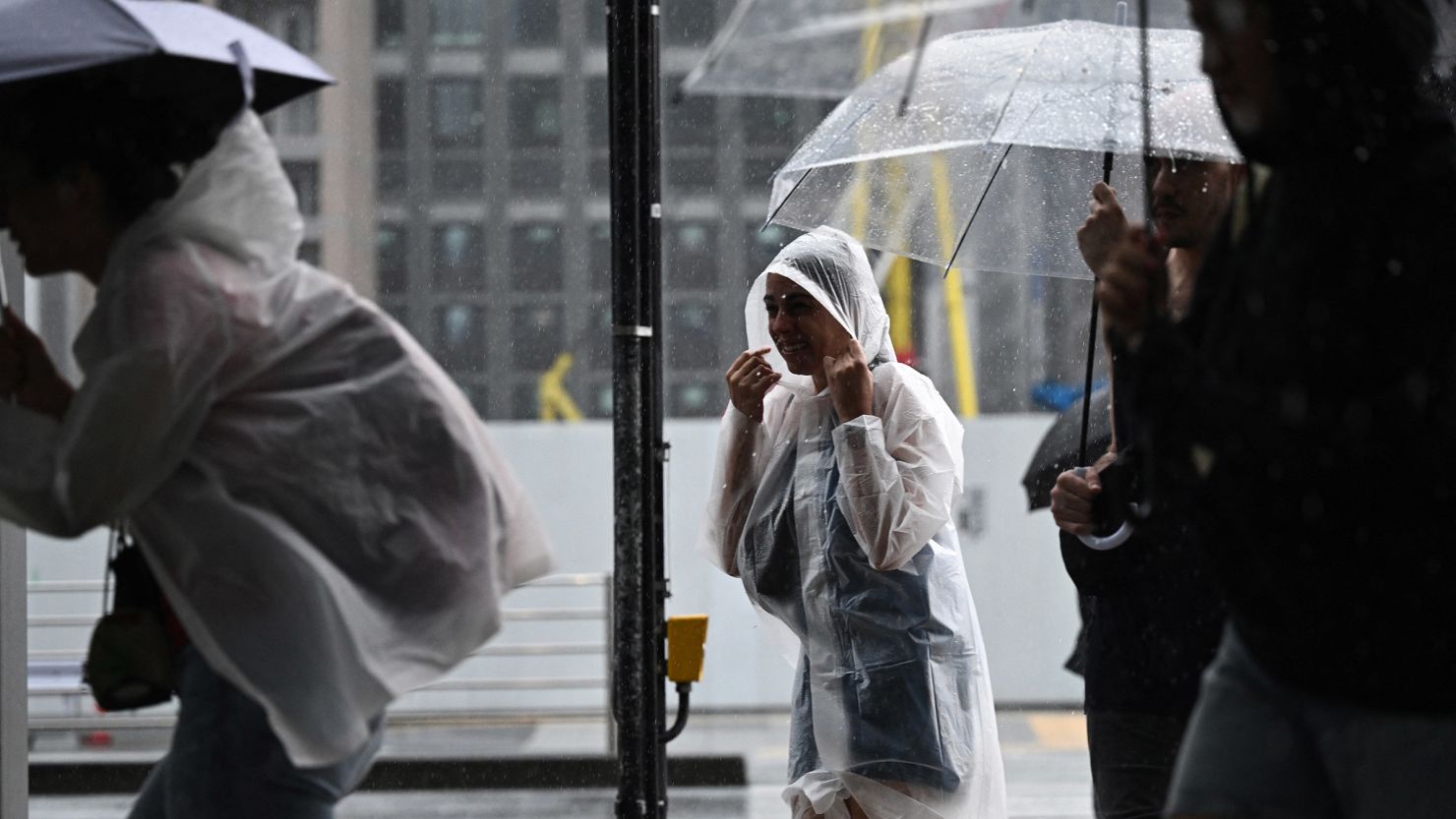
People shield themselves from heavy rain as Typhoon Ampil approaches Tokyo
Hundreds of thousands of people are being advised to evacuate in parts of Japan, with some homes losing power on Friday, as Typhoon Ampil approaches the east coast near the capital
The storm, located 121 nautical miles southeast of Yokosuka, Greater Tokyo, has intensified to the equivalent strength of a Category 4 hurricane, bringing winds of up to 212 kilometers per hour (131 mph) as it moves north at 18 kph (11 mph), according to the Joint Typhoon Warning Center (JTWC).
Ampil has rapidly intensified over the past two days, partly because it moved over very warm water – meaning more moisture in the air to fuel the typhoon. It could strengthen further in the next 12 hours, with the storm reaching peak intensity as it passes by Japan.
More than 178,000 households – nearly 404,000 people in total – were issued evacuation advisories in the cities of Mobara and Asahi near Tokyo and Iwaki, Fukushima prefecture, which are near the east coast expected to feel the brunt of the storm by late Friday. Local authorities called on the elderly, those with disabilities and anyone living in high-risk areas to evacuate.
A similar notice was issued in the city of Yokohama, south of Tokyo, with authorities warning that all residents should be prepared to evacuate.
Japan braces as powerful Typhoon Ampil strengthens near Tokyo
People shield themselves from heavy rain as Typhoon Ampil approaches Tokyo on August 16, 2024.
Hundreds of thousands of people are being advised to evacuate in parts of Japan, with some homes losing power on Friday, as Typhoon Ampil approaches the east coast near the capital.
null
The storm, located 121 nautical miles southeast of Yokosuka, Greater Tokyo, has intensified to the equivalent strength of a Category 4 hurricane, bringing winds of up to 212 kilometers per hour (131 mph) as it moves north at 18 kph (11 mph), according to the Joint Typhoon Warning Center (JTWC).
Ampil has rapidly intensified over the past two days, partly because it moved over very warm water – meaning more moisture in the air to fuel the typhoon. It could strengthen further in the next 12 hours, with the storm reaching peak intensity as it passes by Japan.
More than 178,000 households – nearly 404,000 people in total – were issued evacuation advisories in the cities of Mobara and Asahi near Tokyo and Iwaki, Fukushima prefecture, which are near the east coast expected to feel the brunt of the storm by late Friday. Local authorities called on the elderly, those with disabilities and anyone living in high-risk areas to evacuate.
A similar notice was issued in the city of Yokohama, south of Tokyo, with authorities warning that all residents should be prepared to evacuate.
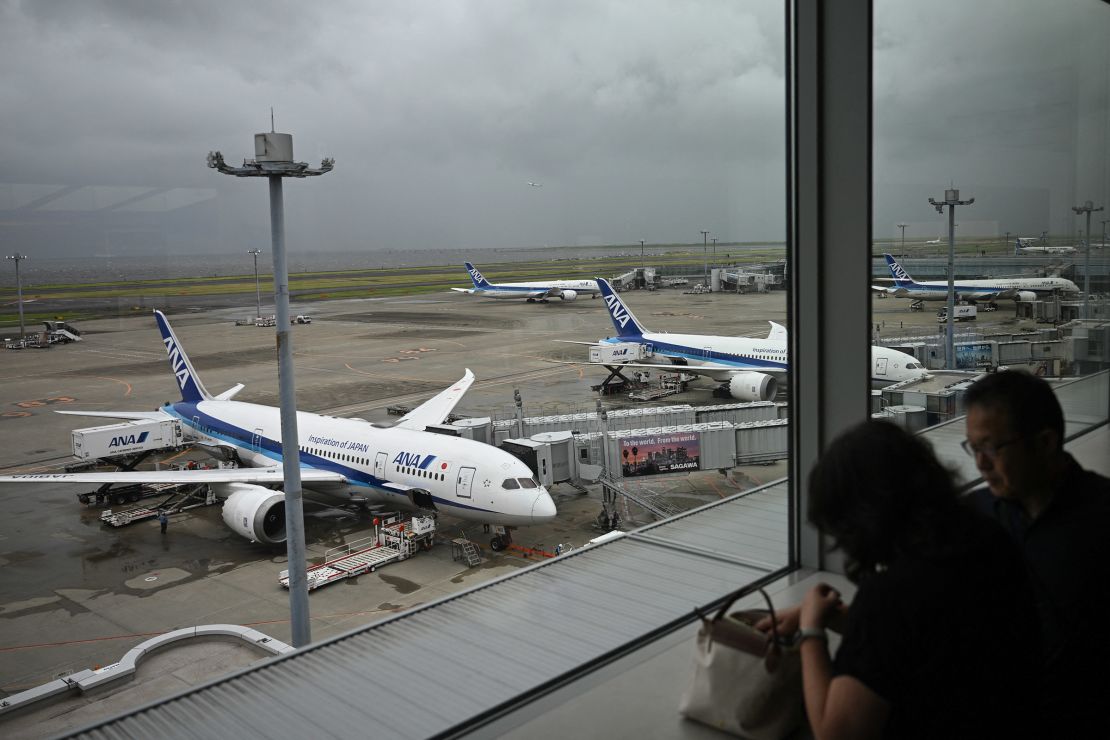
Airlines canceled flights as the storm approached Japan.
By Friday afternoon, as rain and wind picked up in coastal areas, more than 2,000 households lost power, according to electricity company TEPCO.
Two major airlines, Japan Airlines and All Nippon Airways, canceled about 500 flights in total serving the capital’s Haneda and Narita airports, NHK reported.
IRail travel has been disrupted too. Six lines on Japan’s extensive bullet train network are suspending services between certain stations and warning of major delays on Friday – including the key Tokaido line that connects Tokyo with Osaka. Meteorology officials have warned that some parts of northern and eastern Japan may see violent winds, rough seas, heavy rain, flooding, landslides and overflowing rivers, according to NHK. They urged the public to exercise caution and stay prepared.
The storm’s center is expected to remain slightly offshore as it turns toward the northeast and moves away from Japan, according to the JTWC and Japan’s Meteorological Agency. If it stays offshore and only brushes the coast, it might only have a light impact on Japan, bringing rain and wind to some areas including Tokyo.
However, it could have a much stronger effect if the direction changes to bring the center closer to the coast, or even makes landfall.
The storm is expected to weaken by Saturday morning local time and die down as it moves into cooler waters over the weekend.
 mkdmissions.home.blog